Menü

Le Roi du Vin
Weingut, Keller und terroir.
Weingüter und Weinregionen Europas
Sammlung entdecken- 35Orte in der Sammlung
Spitz an der Donau, Wachau — Isiwal · Wikimedia Commons · CC BY-SA 4.0
Die Sammlung
Le Roi du Vin
Weingüter und Weinregionen als Orte der Weinherstellung.

Getariako Txakolina
Getariako Txakolina was recognised as a denomination of origin in 1989. In 2007 its territory expanded to the whole historical territory of Gipuzkoa. Its regulatory council is based in Getaria, and the source describes vineyard renewal preceding the denomination’s recognition.
Editorial selectionCC BY-SA 3.0

Gigondas AOC
Gigondas is a wine appellation in the southern Rhône. INAO places its vineyards in the commune of Gigondas and describes planting on the lower plateau, around the village and on the slopes towards the Dentelles de Montmirail. The map marker is a commune reference point.
Editorial selectionCC BY-SA 3.0

Juridiction de Saint-Émilion
Nouvelle-Aquitaine
The Jurisdiction of Saint-Émilion lies in Gironde, between the Dordogne and the Barbanne. Its UNESCO inscription of 1999 concerns a historic vineyard landscape comprising eight communes, rather than the town alone or an individual château. Vine growing developed through a long history that includes Roman origins and medieval expansion. Religious foundations, pilgrimage and the jurisdiction’s political status also shaped the territory. In Saint-Émilion, the monolithic church, collegiate church and cloister stand alongside secular remains such as the Château du Roi. Beyond the town, estates, wine storehouses and modest workers’ houses record the organisation of wine production. The continued cultivation of vines is fundamental to the property’s significance.
Editorial selectionCC BY-SA 3.0

Kellerviertel Heiligenbrunn
The Kellerviertel above Heiligenbrunn in Burgenland is a historic ensemble of wine cellars and press houses. Austria’s Federal Monuments Authority describes a varied group of agricultural buildings that records pre-industrial wine-growing work. Its separate ensemble record distinguishes this district from the municipality and places it across the Stifterberg, Hochberg and Zeinerberg vineyard slopes. The provincial authority describes the cellar buildings as part of a landscape interwoven with vineyards, orchards, mature trees and woodland. Their uses have changed: the federal agency notes leisure, storage and wine-selling functions, and cautions that the locally sold Uhudler is produced elsewhere.
Editorial selectionCC BY-SA 3.0

Landscape of the Pico Island Vineyard Culture
Pico’s vineyard culture connects stone-walled plots with the volcanic island’s coastal environment. Walls shelter vines from wind and salt spray. Paths, tidal wells and harbour ramps show how growers moved water and wine through the landscape. The inscribed property includes both cultivated plots and abandoned enclosures. The map point is a reference from Portugal’s World Heritage nomination.
Editorial selectionCC BY-SA 2.0

Lavaux
Lavaux is a terraced vineyard landscape above Lake Geneva between Lausanne and Vevey. The heritage association describes its cultivation as extending over more than a thousand years. About 180 winegrowing families cultivate Chasselas and maintain its terrace walls.
Editorial selectionCC BY-SA 4.0
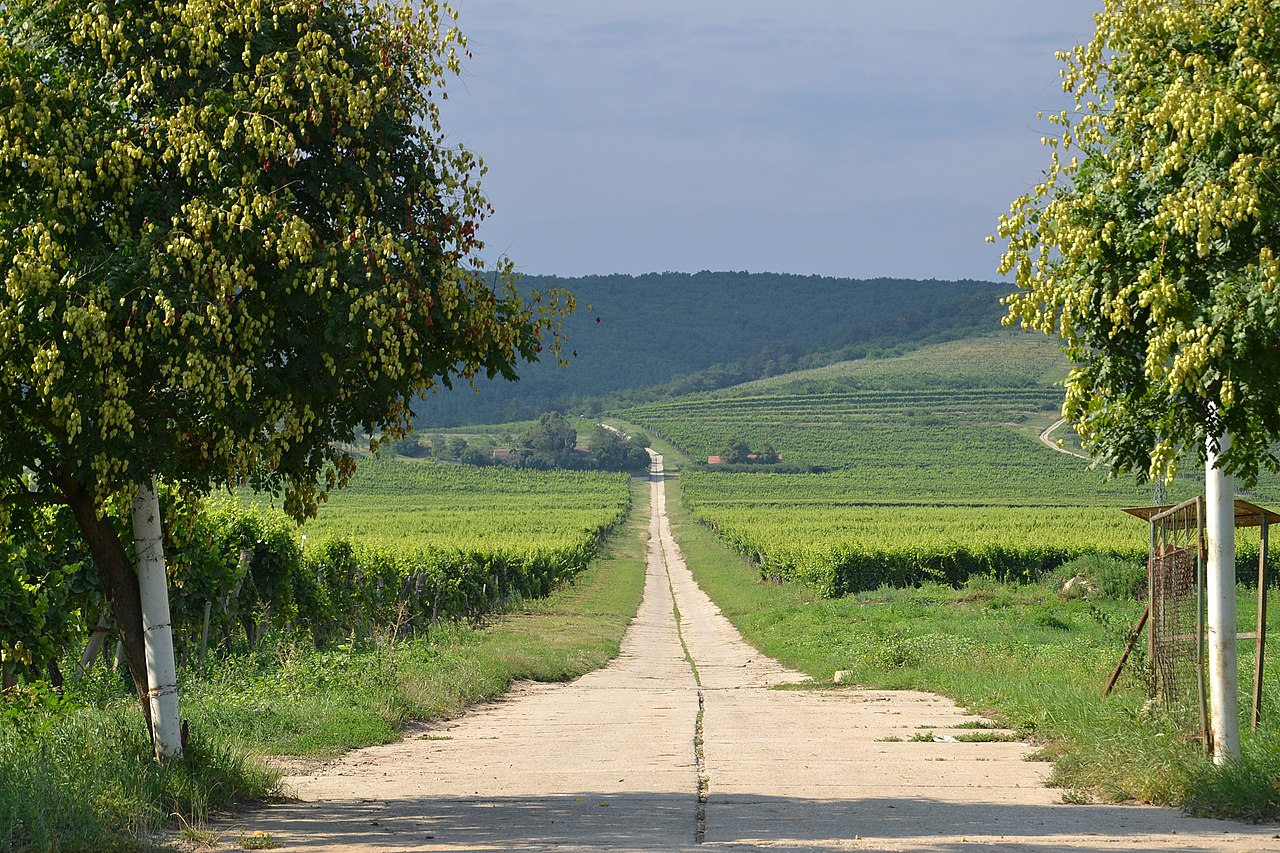
Tokaj wine region
Tokaj’s historic wine landscape in north-east Hungary connects cultivated slopes with settlements and cellar systems. Its setting follows the Bodrog near the Zemplén foothills and the river’s meeting with the Tisza. UNESCO inscribed the Hungarian cultural landscape in 2002; the national heritage account places particular weight on its buildings, long-established settlements and historic cellars. The World Heritage property, its protective zone and the wider wine region should be kept distinct. The Hungarian portal describes 27 settlements across the property and protective zone together. This is not evidence that every part of the wine region has the same heritage status, nor does it extend the Hungarian inscription to similarly named territory across the Slovak border.
Editorial selectionCC BY-SA 4.0

Vineyard Landscape of Piedmont: Langhe-Roero and Monferrato
Inscribed in 2014, the Vineyard Landscape of Piedmont comprises five wine-growing areas and Grinzane Cavour Castle. The map marker uses UNESCO’s reference point for the Langa of Barolo, one of the six components. The designated areas occupy selected parts of the wider landscape.
Editorial selectionCC BY-SA 4.0

Vipava Valley
The Vipava Valley is a winegrowing landscape in western Slovenia. Its official tourism portal describes small vineyards distributed among varied hillsides and terraces, with family farms and historic stone cellars. Mediterranean influences and the northeast Burja wind are part of the region’s winegrowing setting. Alongside internationally familiar grapes, local producers cultivate varieties including Zelen and Pinela. Matija Vertovec’s 1844 work on viticulture and the winegrowing school established at Slap in 1873 form part of the valley’s documented wine history.
Editorial selectionCC BY-SA 3.0

Wachau
Vinea Wachau describes three origin categories for Wachau DAC: regional, local and single-vineyard wines. Its description limits the single-vineyard category to Grüner Veltliner or Riesling grapes from one vineyard and requires hand-harvested grapes in each DAC category.
Editorial selectionCC BY-SA 4.0

Weinviertel
The Weinviertel is a winegrowing landscape of gentle hills and extensive vineyards. Its tourism organisation identifies cellar lanes, wine festivals and Heurigen culture among the region’s characteristic features. The region takes its name from wine.
Editorial selectionCC BY-SA 3.0